

-
Research Article
-
Standardized Property Schema and BOQ-Linked Data Model Design for BIM-Based Budget Execution - A Large-Scale Apartment Housing Case -
BIM기반 실행내역 물량산출을 위한 표준 속성 체계 및 내역 연계형 데이터 모델 설계 - 대규모 공동주택을 중심으로 -
-
SeoungWoo Kang, YongShin An, JeongBeen Kim, SeongMoo Hong
강승우, 안용신, 김정빈, 홍성무
- Extensive research has explored BIM-based Quantity Take-Off (QTO), yet producing a practical Bill of Quantities (BOQ) for execution budgeting remains challenging, particularly …
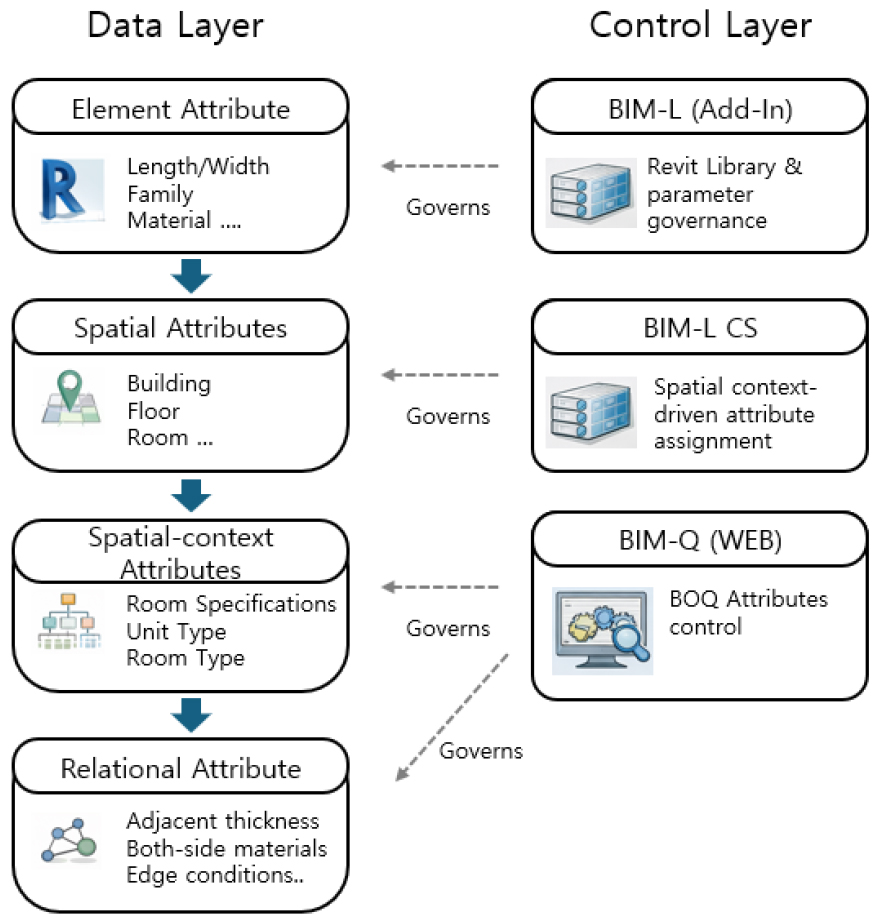
- Extensive research has explored BIM-based Quantity Take-Off (QTO), yet producing a practical Bill of Quantities (BOQ) for execution budgeting remains challenging, particularly for finishing works, due to complex information requirements and frequent project-specific variations. This study proposes a standardized property system and a BOQ-linked relational database schema to automate execution BOQ generation for large-scale apartment housing projects. The core contribution is a property-rule-mapping layer that structurally decouples BIM object data from cost items. This deterministic 1:N mapping approach intrinsically prevents rule conflicts and enables the system to adapt to changes in the Cost Breakdown Structure (CBS) or construction methods by updating database queries without modifying the source code. The approach was implemented in an in-house Revit-based system and validated across multiple projects from 2023 to 2025. Quantitative results demonstrate significant system stabilization as project data accumulated: the new rule creation ratio dramatically decreased from 13.63% to 0.53%, system errors were completely eliminated, and the rule stabilization index reached 99.47%. Scalability was further examined using the Korea Land & Housing Corporation (LH) library and heterogeneous BIM software. Despite differences in modeling standards, external data were successfully integrated through object decomposition and additional rule definitions alone, demonstrating high interoperability and supporting the model's potential as a reusable platform for construction cost management. - COLLAPSE
-
Standardized Property Schema and BOQ-Linked Data Model Design for BIM-Based Budget Execution - A Large-Scale Apartment Housing Case -
-
Research Article
-
A Microscopic Pedestrian Simulation Approach for User-Centered Transit Service Efficiency Design
미시적 보행 시뮬레이션 VISSIM을 활용한 이용자 중심 환승 서비스 효율화 설계 연구
-
Hye-In Kwon, Woo-Jin Cho, Jun-Hyeok Ahn, Jae-Seung Lee
권혜인, 조우진, 안준혁, 이제승
- The purpose of this study is to develop a user-centered strategy for improving transfer efficiency in a multimodal transit hub by integrating …
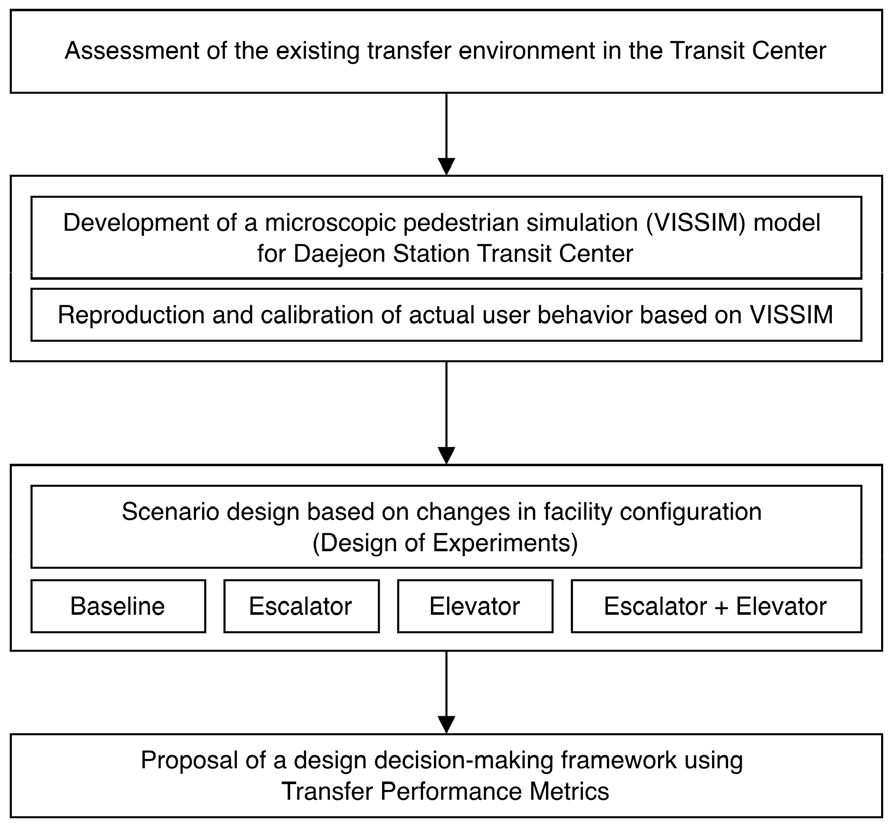
- The purpose of this study is to develop a user-centered strategy for improving transfer efficiency in a multimodal transit hub by integrating microscopic pedestrian simulation with the Design of Experiments (DOE) approach. Daejeon Station Transit Hub was selected as the case study, and simulation inputs were constructed using on-site field observations and KORAIL boarding and alighting statistics, including pedestrian demand, transfer routes, and spatial configurations. A microscopic pedestrian simulation model was developed in VISSIM based on the Social Force Model. In addition, a 2×2 factorial experiment was designed using escalator addition and elevator service expansionas the main design factors, resulting in four scenarios (S1–S4). Transfer performance was evaluated using Weighted Average Converted Distance (WACD) and transfer time. The results show that the combined improvement scenario (S4) achieved the highest overall efficiency, reducing WACD by approximately 20% and transfer time by about 10% compared with the baseline scenario (S1). DOE analysis further identified significant main effects and an interaction effect between the two facilities, indicating that their combined impact is not a simple additive effect but an interdependent and non-linear relationship within the transfer system. These findings suggest that integrated vertical circulation planning is more effective than isolated facility provision for improving user convenience and operational efficiency. Although this study is based on a single case, it presents an evidence-based analytical framework that combines field observation, microscopic simulation, and experimental design, and it may be extended to the planning and operation of other complex transit hubs. - COLLAPSE
-
A Microscopic Pedestrian Simulation Approach for User-Centered Transit Service Efficiency Design
-
Research Article
-
Development of BIM-Based Quality Check Automation System for Enhancing Productivity of BIM Deliverables
BIM 성과품 품질검토 생산성 향상을 위한 BIM 적용지침 기반 품질검토 자동화 시스템 개발
-
Woochan Kim, Yun-Sang Song, Geun-il Lee, Jehee Han, Dong Koo Gwak
김우찬, 송윤상, 이근일, 한제희, 곽동구
- As Digital Transformation (DX) accelerates in the construction industry, Building Information Modeling (BIM) has become a core technology for integrating information throughout …
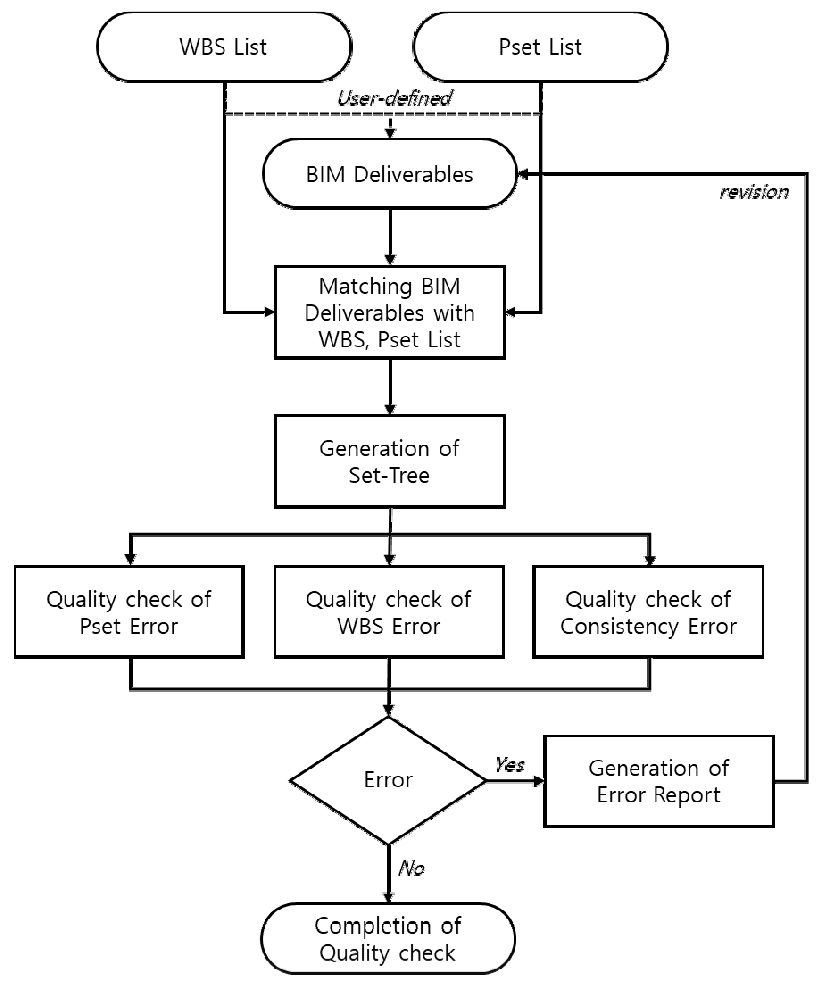
- As Digital Transformation (DX) accelerates in the construction industry, Building Information Modeling (BIM) has become a core technology for integrating information throughout a project's lifecycle. Public client organizations have established BIM guidelines to ensure data reliability; however, quality check for logical data—such as Work Breakdown Structure (WBS) and Property Sets (Pset)—remains a labor-intensive process prone to human error. This is particularly challenging in site development projects, which involve a vast number of complex objects compared to building projects. This study proposes a rule-based quality check methodology for BIM deliverables, specifically tailored for site development, based on Korean BIM guidelines. By customizing these guidelines into a reference for quality checks, the research developed an automated software solution as an Autodesk Navisworks Add-in. The software focuses on three critical logical check items: WBS consistency, WBS omission, and Pset omission. To verify the system's performance, a pilot test was conducted using a site development BIM model with 14 artificially embedded errors. The results demonstrated that the software successfully detected 100% of the errors and generated detailed error reports. Notably, the automated process reduced quality check time by approximately 99% compared to manual methods. Furthermore, the system ensured consistent results regardless of the user's BIM proficiency. - COLLAPSE
-
Development of BIM-Based Quality Check Automation System for Enhancing Productivity of BIM Deliverables

 Journal of KIBIM








 Journal of KIBIM
한국BIM학회
(06130) Journal Office Room #1005-1, KSTC Main Building, 7Gil 22, Teheran-ro, Gangnam-gu, Seoul, Korea
Tel: +82-2-567-4478 / Fax: +82-2-552-4729 / E-mail: kibim@kibim.or.kr Copyright© Journal of KIBIM. Powered by APUB
Tel: +82-2-567-4478 / Fax: +82-2-552-4729 / E-mail: kibim@kibim.or.kr Copyright© Journal of KIBIM. Powered by APUB